If you’ve Googled answer engine optimization in 2026, you’ve noticed the same shift everyone else has: a growing share of searches now end inside an AI-generated answer panel — Google AI Overview, Perplexity, ChatGPT, Bing Copilot — without users ever clicking a link. AEO is the discipline of getting your content cited inside those answers. We build Ranket, an AI SEO automation tool that ships AEO-ready structure on every article. This is the definitive 2026 reference.
TL;DR: AEO is the practical work of making your content quotable by answer engines. Seven ranking factors matter: direct-answer format, JSON-LD schema, entity clarity, source authority, recency, citation density, and structured-data presence. Read the 7 factors, the content templates, or the FAQ.
Heads up — Google’s official 2026 position. Google’s GenAI Search guidance is explicit: from Google’s perspective, “AEO” and “GEO” are not separate disciplines from SEO — they describe optimizing for the same Search experience. The mechanics in this guide (direct answers, JSON-LD, citation density, entity clarity, source authority) still matter because they’re what every answer engine — Google’s and the LLM-first engines like Perplexity and ChatGPT — actually use to pick what to cite. Treat AEO as SEO done well for the answer-driven era, not as a parallel discipline with new hacks. Brands that focus on unique, non-commodity, first-hand content win on both surfaces.
What Answer Engine Optimization (AEO) is
Answer Engine Optimization is the practice of structuring content so that “answer engines” — AI systems that synthesize responses to user queries — cite or incorporate your content into their answers. The four answer engines that matter in 2026 are Google AI Overview, Perplexity, ChatGPT (with web browsing / SearchGPT), and Bing Copilot.
The shift AEO addresses is a structural one in user behavior. In 2023, a search for “best CRM for B2B SaaS” returned ten links and the user clicked one. In 2026, the same search returns a synthesized answer naming three CRMs, with brief explanations of each. The user gets the answer without clicking — but the brands named in the answer get the credibility win, and a fraction of users do click through to the source.
If your brand isn’t named in the answer, you’re invisible to that user — even if your site would have ranked #2 in a traditional Google SERP. AEO is how you make sure you’re named.
For how the term itself is being used in the wild, the r/DigitalMarketing thread What is Answer Engine Optimization (AEO)? is a useful read — the discipline is still defining itself in the open.
AEO vs. SEO vs. GEO — the differences that matter
The category has three names. They overlap heavily but have distinct emphases:
| Discipline | Optimizes for | Primary signals |
|---|---|---|
| SEO | Google’s blue-link rankings | Backlinks, on-page keywords, page speed, E-E-A-T |
| GEO (Generative Engine Optimization) | Generative AI citations broadly | Schema, entity clarity, training-data prominence |
| AEO (Answer Engine Optimization) | Specific answer engines (AI Overview, Perplexity) | Direct answers, schema, source authority, recency |
GEO is the academic term, introduced in a 2023 research paper. AEO is the marketing term that gained traction in 2024–2025 as Google AI Overview rolled out. LLM SEO is the practical day-to-day work term. For most teams the distinctions are pedantic — the optimization work is largely the same.
What’s specifically AEO (vs. broader GEO/LLM SEO):
- More emphasis on Google AI Overview specifically (since it sits at the top of the SERP for billions of queries)
- More emphasis on E-E-A-T-style authority signals (Google still cares)
- More emphasis on direct-answer paragraph format (the literal text answer engines lift)
We cover the broader LLM ranking work in How to rank on ChatGPT, Claude, and Perplexity. This guide focuses on the AEO-specific lens.
Why AEO matters in 2026 (the “zero-click” shift)
The single statistic that makes AEO unavoidable: zero-click search rate. In 2020, roughly 65% of Google searches resulted in zero clicks (the user got the answer from the SERP without clicking). In 2026, that number is approaching 75–80% for high-intent informational queries — driven primarily by AI Overview expansion.
Translation: even if you rank #1 traditionally, the AI Overview answer above you may capture the user. The traditional SEO playbook still drives traffic for transactional queries (purchases, signups, downloads), but it’s losing share on informational ones (definitions, comparisons, “how does X work”).
The defensive read: AEO is how you stay visible as the click rate compresses. The offensive read: AEO is how you appear in answers Google’s traditional ranking wouldn’t have surfaced you for. Both reads point to the same conclusion — start optimizing for it now, while the field is uncrowded.
The pain is loud in practitioner threads — see r/SEO’s How much damage does AI Overview do to a website’s traffic? and r/DigitalMarketing’s 60% of Google searches now end without a click for first-hand impact data.
The rest of this guide is the practical playbook.
The 4 types of answer engines
Each answer engine works slightly differently. The optimization signals overlap, but knowing the differences helps prioritize.
Google AI Overview — sits at the top of Google’s SERP for ~30% of US informational queries (and growing). Bridges traditional SEO (still cares about backlinks, E-E-A-T) and LLM ranking (rewards schema, direct answers). The AI Overview source panel shows 3–5 cited sources per answer.
Perplexity — pure AI-search interface. Heavy reliance on live web search (meaning recency matters a lot). Answers always show citation badges with clickable source links — often higher CTR than Google AI Overview. Most receptive to new content if structured well.
ChatGPT (with browsing / SearchGPT) — leans heavily on training-data prominence for general queries. Switches to live web search for time-sensitive queries. Cites 2–4 sources per answer with inline links. Newer brands have a steeper climb because of the training-data weight.
Bing Copilot — Microsoft’s Edge sidebar and search integration. Uses GPT-4 class models with Bing’s search index. Cites sources with footnote-style numbers. Volume is meaningfully smaller than Google AI Overview but conversion is high.
Practical implication: Google AI Overview and Perplexity are the highest-leverage answer engines to optimize for first. Both reward AEO best-practices (schema, direct answers, recency) and have feedback loops measured in weeks, not months.
The 7 ranking factors specific to AEO
The factors that matter for AEO in 2026, ranked by impact:
- Direct-answer format — every section opens with a 40–60 word direct answer
- JSON-LD schema — Article + FAQPage + HowTo as relevant
- Entity clarity — disambiguating descriptors on every brand mention
- Source authority — domain authority, brand mentions in established publications, Wikipedia reference
- Recency — recent publication date, fresh internal links, updated statistics
- Citation density — inline links to primary sources, bibliographic-style attribution
- Structured-data presence — tables, lists, code blocks, comparison matrices that answer engines can lift verbatim
We’ll walk through each in the next sections. The first three are the highest-leverage and easiest to act on. The last four take longer (months, not weeks) to move.
Factor 1: Direct-answer format
The single highest-impact AEO change you can make. Answer engines don’t read chapters — they extract paragraphs.
The pattern that wins:
Under every H2 heading, write a 40–60 word direct answer to the implicit question the H2 asks. Then write the deeper supporting content underneath.
Example. H2: “Why is AEO different from SEO?”
Direct answer (52 words):
AEO optimizes for AI-generated answer engines (Google AI Overview, Perplexity, ChatGPT). SEO optimizes for traditional Google blue-link rankings. AEO weights direct-answer format, schema markup, and entity clarity. SEO weights backlinks and on-page keywords. The disciplines overlap; the practical optimization work is roughly 70% the same.
Then the deeper detail underneath — exceptions, nuance, examples.
The reason this works: answer engines are trained to recognize concise definitional paragraphs as high-value retrieval units. A 1,500-word section with no direct answer at the top gets ignored. A 1,500-word section with a tight 50-word answer at the top gets the answer cited in AI Overview, with a link back to the section.
We use this pattern on every Ranket blog (this article included) and on every article we generate for customers. Look at the first paragraph under each H2 in this post — that’s the answer-engine-extractable unit.
Factor 2: JSON-LD schema
Schema markup is the machine-readable description of your content. Answer engines use it to know what your content is about without inferring from prose.
The four schema types that matter for AEO:
- Article — every blog post should have it. Contains headline, description, author, publisher, datePublished, mainEntityOfPage.
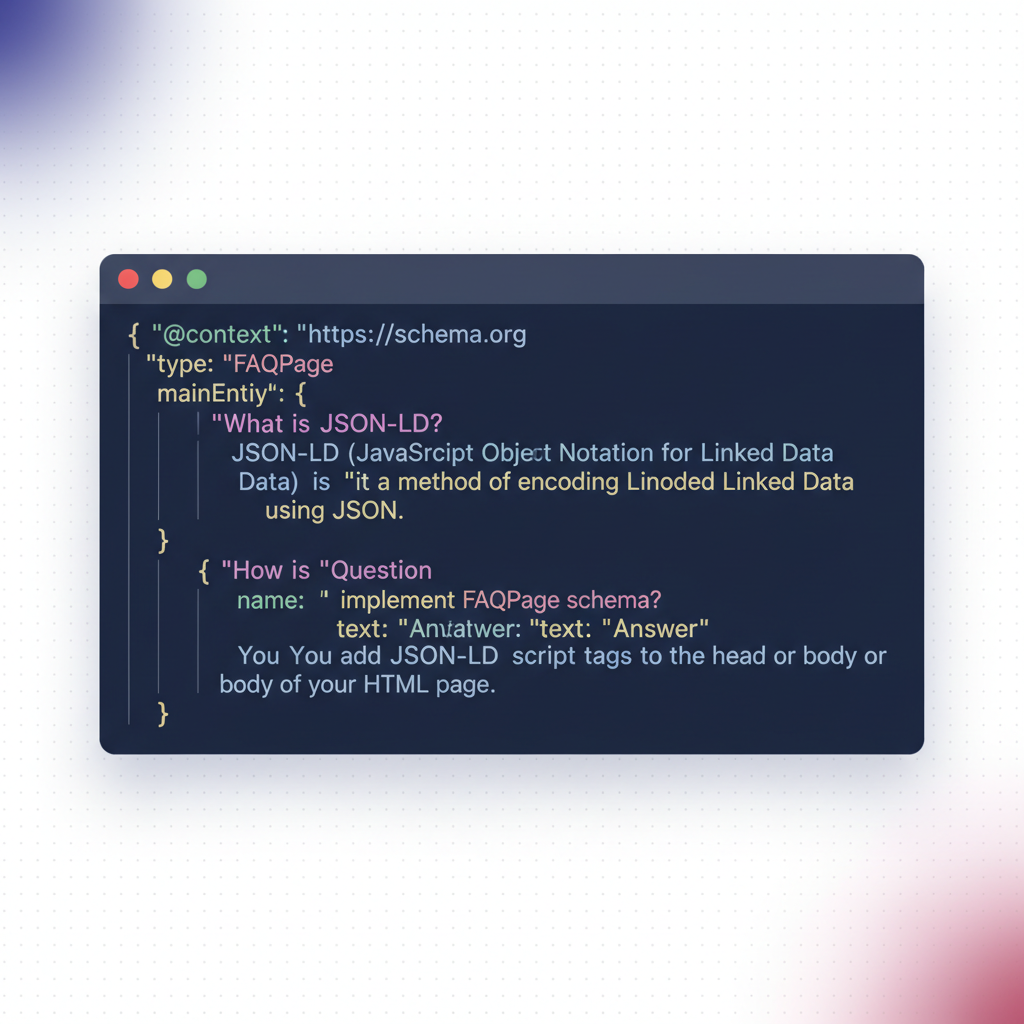
- FAQPage — for any post with a Q&A section. Each Q+A becomes a discrete unit answer engines lift verbatim. Highest AEO-impact schema type.
- HowTo — for tutorials and step-by-step guides. Steps become discrete units.
- Product — for product pages, comparison pages, pricing pages.
A working FAQPage block:
{
  "@context": "https://schema.org",
  "@type": "FAQPage",
  "mainEntity": [{
    "@type": "Question",
    "name": "What is AEO?",
    "acceptedAnswer": {
      "@type": "Answer",
      "text": "Answer Engine Optimization (AEO) is the practice of structuring content so that AI answer engines like Google AI Overview, Perplexity, and ChatGPT cite or incorporate your content into their generated answers."
    }
  }]
}
Schema needs to be on every article. The mistake: adding it to a few SEO-conscious posts and forgetting the rest. Ranket emits schema by default. Manual alternatives: a WordPress plugin like Rank Math, or a custom Astro/Next.js component.
Factor 3: Entity clarity
Answer engines need to know who and what your content is about. “Tesla” alone is ambiguous. “Tesla, Inc. (NASDAQ: TSLA), the electric vehicle manufacturer” is unambiguous.
Three places to bake in entity clarity:
- First mention — every brand or product name gets a disambiguating descriptor on first mention in each major section
sameAsschema — linkArticle.publisherorOrganizationschema to Wikipedia, Crunchbase, Wikidata viasameAsURLs- Author bio + Person schema —
Personschema withsameAspointing to LinkedIn, Twitter, ORCID. Signals real-human authorship.
For new brands without Wikipedia presence: aim to get a Wikipedia mention within 12 months. Wikipedia entries are the strongest possible entity-clarity signal because almost every modern model’s training data heavily weights Wikipedia. We cover this in our AI visibility tool guide.
Factor 4: Source authority
The harder, longer-tail factor. Answer engines lean on the same authority signals Google has always cared about, plus a few that matter more for AEO:
- Domain authority — backlinks from established sites, age of domain
- Brand mentions in established publications — even unlinked mentions count as entity reinforcement
- Wikipedia presence — the strongest authority signal for AEO
- Author authority — published author profile, public expertise signals (LinkedIn, conference talks, books, papers)
You can’t shortcut authority. The 12-month plays:
- Get cited by tier-1 publications in your category (NYT, WSJ, Bloomberg, TechCrunch for tech, Forbes for business)
- Build author profile on LinkedIn with public expertise signals
- Pitch one Wikipedia edit per quarter referencing your brand (only if genuinely notable enough to merit it)
- Speak at conferences in your category
Authority compounds. The brands that dominate AEO in 2027 are the ones building authority signals now.
Factor 5: Recency
Answer engines weight recent content heavily. Three reasons:
- LLMs refresh their training data on a rolling basis (months, not days). Recent content gets indexed faster.
- Live-search-based engines (Perplexity, Google AI Overview) explicitly check publication dates.
- Users implicitly want fresh answers — answer engines are tuned to surface recent sources for time-sensitive queries.
Practical recency tactics:
- Update your top-performing articles every 6 months. Change the publication date in the schema.
- Add “Updated for 2026” in the title where genuine
- Refresh statistics, examples, and tool mentions
- Check internal links — orphan pages and broken links signal staleness
The fastest way to lose AEO ranking: let your top article go untouched for 18 months while competitors publish 2026-fresh versions. The optimization loop in Ranket handles this automatically — flagging articles where the date stamp is more than 12 months old and proposing a refresh.
Factor 6: Citation density
Answer engines reward content that cites primary sources because it lets them attribute claims back. Content with no sourcing has nowhere to attribute to.
The structural rules:
- Inline links to primary sources for every statistic, claim, or quote
- Author + date attribution for studies, papers, reports
- Direct quotes with attribution to source publication
- Specific numbers — “$1.2 billion market by 2030” is citable; “a growing market” isn’t
The most common AEO failure mode: generic claims with no source. “Many studies show that X” is the canonical bad pattern — no answer engine will cite it because there’s no source to attribute. “A 2023 Stanford study (Aggarwal et al., ‘GEO: Generative Engine Optimization’) found that…” is citable.
When in doubt, link out. Outbound citation density is positively correlated with AEO ranking. The instinct to “keep all the link juice on the page” is outdated SEO folklore that actively hurts AEO citation.
Factor 7: Structured-data presence
Beyond JSON-LD schema, answer engines lift specific structural elements verbatim:
- Tables — comparison tables, pricing tables, feature matrices
- Numbered or bulleted lists — step-by-step instructions, checklists
- Code blocks — for technical content, the literal code is often what answer engines quote
- Definitions — term + definition pairs (often pulled into Google’s featured-snippet-style “definition box”)
- Comparison matrices — feature × tool grids
The pattern: if you want answer engines to lift a piece of information verbatim, make it structurally extractable. Buried in a paragraph, it gets paraphrased (or skipped). Formatted as a table or list, it gets lifted directly.
This is also what works for traditional Google featured snippets — the optimization work overlaps almost entirely.
AEO content structure templates
Two templates we use ourselves and recommend.
Template 1: Definitional + practical (this article)
# [Topic] [Year]: [Definitional + Practical Promise]

[200-word intro with TL;DR + skip-links]

## What [Topic] is
- 40-60 word direct answer
- Deeper context

## Why it matters in 2026
- 40-60 word direct answer
- Statistics, trends

## The N factors / signals / steps
- Numbered list with brief intros

## Factor 1: [Specific factor]
- 40-60 word direct answer
- Tactics, examples, code blocks

[Repeat for each factor]

## [Topic] FAQ
- 8 questions in <details> + JSON-LD FAQPage

## Related guides
- Internal links
Template 2: Listicle / comparison
# Best [Category] in 2026 (Compared)

[200-word intro with TL;DR table]

## At-a-glance comparison table

[Table with all options]

## How we tested
- Methodology paragraph

## The N best [category]

### 1. [Tool A] — best for [use case]
- 40-60 word summary
- Pros / cons

[Repeat per tool]

## How to choose
- Decision framework

## [Category] FAQ
- 8 questions
Both templates have the same DNA: direct answers under each H2, FAQPage schema, honest comparisons, internal links. The variations are surface-level.
How to optimize an existing article for AEO
A 30-minute audit you can run on your top-performing articles:
- Check 1 (2 min) — does each H2 have a 40–60 word direct answer immediately underneath? If not, write one for each.
- Check 2 (3 min) — is JSON-LD schema (Article + FAQPage if you have a Q&A section) present and valid? Test at Google’s Rich Results Test.
- Check 3 (5 min) — is the brand name disambiguated on first mention? Add a descriptor.
- Check 4 (5 min) — every statistic and quote has an inline link to a primary source? Add links.
- Check 5 (5 min) — is the publication date within the last 12 months? If not, refresh content + update date.
- Check 6 (5 min) — are there 8+ internal links to related articles? Add if missing.
- Check 7 (5 min) — submit URL to GSC URL Inspection tool, request reindex.
Run this on your top 10 articles in one afternoon. The compounding lift across those 10 articles typically delivers a 30–60% increase in Google AI Overview appearances within 60 days.
AEO measurement: how to know if it’s working
Three measurement approaches in 2026:
- Google Search Console — AI Overview impressions report (now in beta). Shows when your content appears in an AI Overview answer panel and how often users click through.
- Direct LLM testing — manually ask ChatGPT, Claude, Perplexity the top 5 questions in your category each week, note whether your brand appears. Crude but informative.
- Citation tracking tools — Profound, Otterly.ai, or Ranket’s built-in tracker. Automated monitoring across multiple LLMs.
Baseline metrics to track:
- Citation rate per query — what % of relevant queries cite your content
- Position-in-answer — when cited, where in the answer panel (first citation > third)
- Click-through from AI Overview — appearing in the answer is good; click-through to your site is better
- Brand mention rate — even uncited mentions matter for entity reinforcement
Track week-over-week. AEO moves faster than Google SEO — meaningful changes appear in 2–4 weeks rather than 3–6 months. For a sense of how other teams are running their measurement, the r/SEO thread Google says AI Overviews haven’t hurt clicks — but is that true? collects practitioners’ own GSC data alongside Google’s official numbers.
AEO mistakes that backfire
Patterns that look like AEO optimization but actively hurt:
- FAQPage schema spam — adding schema for questions not actually answered in the article. Google penalizes this.
- Keyword stuffing the LLM way — repeating “ChatGPT, Claude, Perplexity” 50 times. Doesn’t help.
- Fake citations — linking to sources that don’t actually support the claim. Both Google and LLMs detect this and penalize.
- Hidden FAQ schema — schema markup with content not visible to users. Google’s spam policy explicitly forbids this.
- No real answer in the direct-answer paragraph — paragraph that promises to answer but doesn’t. LLMs skip these.
- Blocking GPTBot in robots.txt — prevents training-data inclusion, permanently reduces long-term ChatGPT citation
- Generic AI content with no human voice — answer engines cite content with unique perspective, not generic summaries
The defensive read: AEO has its own version of the spam-vs-real divide that traditional SEO had. Tactics that look quick-win usually backfire.
AEO in 12 months: predictions + what to bet on
Three predictions for the AEO landscape:
- Google AI Overview will reach 60%+ of US informational queries by mid-2027. The expansion is irreversible. Optimizing for AI Overview now is the obvious bet.
- A new tier of “AEO analytics” tools will emerge. Profound and Otterly.ai are early. Expect 5+ serious tools by 2027 and consolidation by 2028.
- The line between SEO and AEO will blur back into one practice. “AEO” as a separate term will fade as the disciplines merge structurally.
What to bet on as a content strategy:
- Direct-answer format on every article — high leverage, low cost
- Schema on every article — table-stakes
- Content refresh cadence (every 6 months on top performers) — easy compound gain
- Citation density — easy to add, hard for competitors to fake
- Author authority — long-tail compound, start now
Skip:
- Trying to game GPTBot training data inclusion via tactics — Google and OpenAI detect manipulation
- Building schema for content that doesn’t exist on the page — explicit policy violation
- Chasing the “rank on ChatGPT” trend at the expense of Google SEO — they coexist
Answer Engine Optimization FAQ
Is Answer Engine Optimization the same as SEO?
No, but they overlap heavily. SEO optimizes for Google’s blue-link rankings. AEO optimizes for AI-generated answer engines (Google AI Overview, Perplexity, ChatGPT). The signals overlap roughly 70%, but AEO emphasizes direct-answer format, JSON-LD schema, and entity clarity more than traditional SEO.
How is AEO different from GEO?
GEO (Generative Engine Optimization) is the academic term, introduced in a 2023 research paper. AEO (Answer Engine Optimization) is the marketing term that gained traction with Google AI Overview’s rollout. The optimization work is largely the same — the distinctions are pedantic for most teams.
Will AEO replace traditional SEO?
No. Traditional SEO still drives traffic for transactional queries (purchases, signups, downloads) where users actually click through. AEO captures the share that shifts to answer engines for informational queries. Smart teams optimize for both — the signals overlap heavily.
How do I optimize for Google AI Overview specifically?
Five things in priority order: (1) JSON-LD schema on every article, (2) 40–60 word direct-answer paragraphs under every H2, (3) entity clarity (brand name with disambiguating descriptor), (4) inline citations to primary sources, (5) recent publication date. Validate schema at Google’s Rich Results Test before publishing.
Does AEO require different content than SEO?
Mostly the same content with structural tweaks. The biggest changes: shorter, more direct paragraphs under each H2 (vs. long-form prose), more inline citations, explicit disambiguation of brand names. The actual topics and angles are identical to good SEO content.
How do I measure AEO performance?
Three approaches: (1) Google Search Console’s AI Overview impressions report (in beta), (2) manual LLM testing — ask ChatGPT/Claude/Perplexity the top queries weekly, (3) citation tracking tools like Profound, Otterly.ai, or Ranket’s built-in tracker. Track citation rate per query and click-through from answer panels.
What schema types matter most for AEO?
Four schema types in priority order: Article (every blog post), FAQPage (any post with Q&A — highest AEO impact), HowTo (tutorials), Product (product / comparison / pricing pages). Add Author Person schema with sameAs links for authority signals.
Can AEO work for B2B SaaS, or is it only for consumer queries?
Both. B2B SaaS arguably benefits more because B2B buyers do extensive pre-purchase research in answer engines (ChatGPT and Perplexity especially) before ever clicking through to a product website. Comparison content (“[Tool A] vs [Tool B]”) and category content (“best [category] for [use case]”) perform particularly well in answer engines for B2B.