If you’re searching for SEO automation in 2026, you’re not asking whether to automate — you’re asking which parts and with what stack. This guide is the answer. We’ll walk through the six stages of a fully automated SEO pipeline, the tools that handle each one, the costs to expect at scale, and where automation still genuinely fails. We build one of the tools in the stack (Ranket), so the parts where automation falls short get the honest treatment they deserve.
TL;DR: A 2026 SEO automation pipeline replaces six jobs — keyword researcher, SEO strategist, content writer, publisher, link builder, and content optimizer — with one loop that runs daily. Costs land between €0.05 and €1.20 per published article depending on model choice, with cache-aware Sonnet-tier setups around €0.30. Skip to the cost breakdown, the best SEO automation tools, or the FAQ.
What SEO automation actually is in 2026
SEO automation is the practice of replacing manual SEO labor with software loops that research, write, publish, and optimize content with little to no human involvement. The phrase is older than the AI wave — Ahrefs and Semrush have used “automation” to describe rank tracking and audits for a decade. What’s new in 2026 is end-to-end automation: a keyword that didn’t exist on Monday becomes a published, internally-linked, schema-rich article on Friday, then gets surgically rewritten in week six when its position stalls at #14.
The category splits along two axes. What gets automated — research only, writing only, or the whole loop. And how much human review is built in — fully autonomous, human-in-the-loop, or human-approves-each-step. The most useful 2026 setups sit in the middle: fully autonomous on routine content, human review for money pages and high-stakes pillars.
The reason this matters for your stack choice is that “AI SEO tool” and “SEO automation tool” mean very different things. An AI SEO tool typically helps a human write better content (Surfer, Frase). An SEO automation tool runs the full loop without a human in the editing seat (Ranket, BlogSEO, Outrank). If you have a writing team, the first category fits. If you’re a founder or small team and the content writer is you — automation wins on cost, throughput, and consistency.
The r/SEO community has been arguing this distinction for two years — the thread How AI-generated content performs in Google Search is a representative snapshot of where practitioners actually stand.
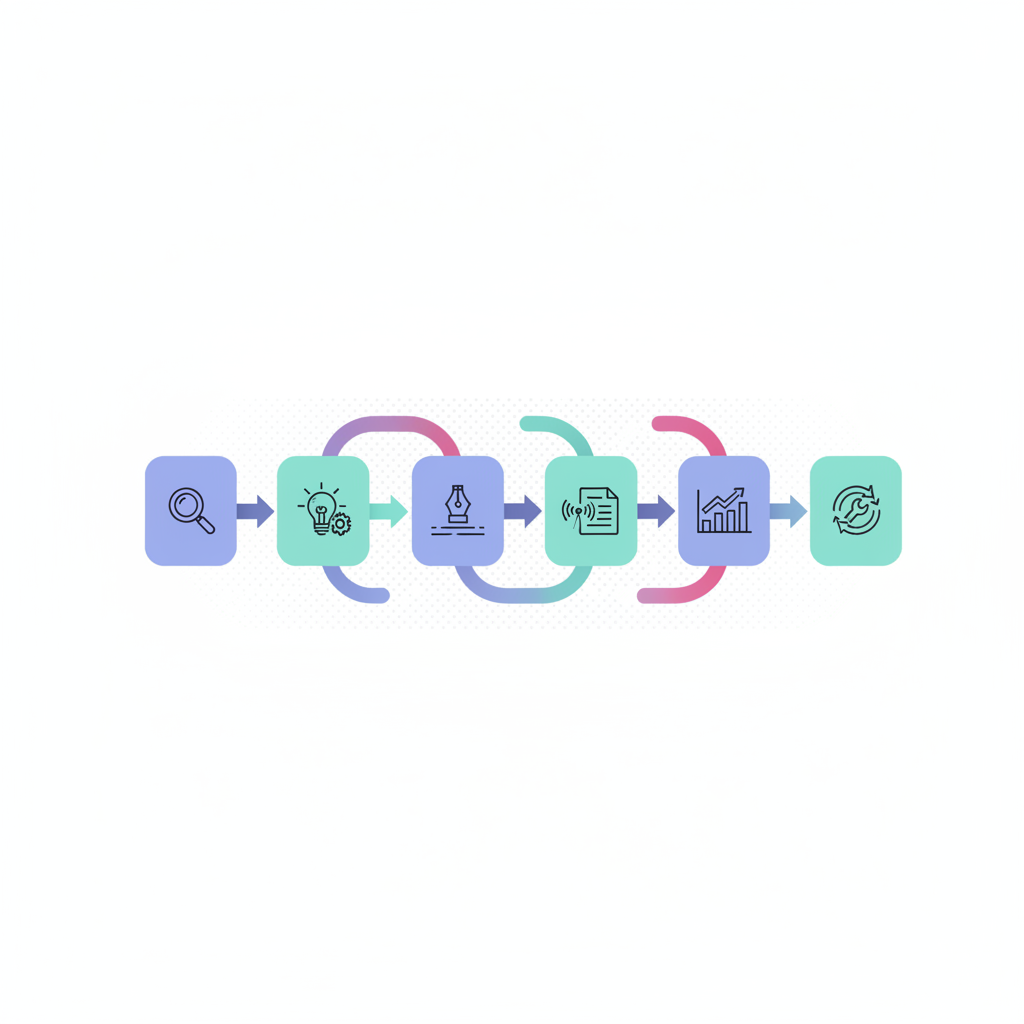
The 6 stages of an automated SEO pipeline
Every functional 2026 SEO automation stack does the same six things, in this order:
- Research — discover keyword opportunities scored by your real domain authority
- Strategy — decide what to write, in what format, against which competitors
- Write — produce a long-form article that doesn’t read like AI fog
- Publish — push it to your CMS without manual copy-paste
- Measure — pull ranking, traffic, and conversion data back into the loop
- Optimize — rewrite under-performing articles using real performance data
The mistake most “AI content tool” buyers make is shopping for stage 3 only. Buying a writer without research → strategy → publishing → measurement → optimization is like buying a car engine without wheels. The output is real but it doesn’t take you anywhere.
The rest of this guide walks each stage in detail.
Stage 1: Keyword research automation
Manual keyword research takes hours per article: pull SERPs from Ahrefs, score by volume and KD, manually filter by relevance, paste into a spreadsheet, choose targets. Automated research collapses this to a 30-second job per brand per week.
The 2026 stack uses three signal sources stitched together:
- DataForSEO or Semrush API — head terms, related keywords, search volume, KD
- Google Search Console — your real impressions and positions (the only “ground truth”)
- Your own site — niche, audience, brand context to filter relevance
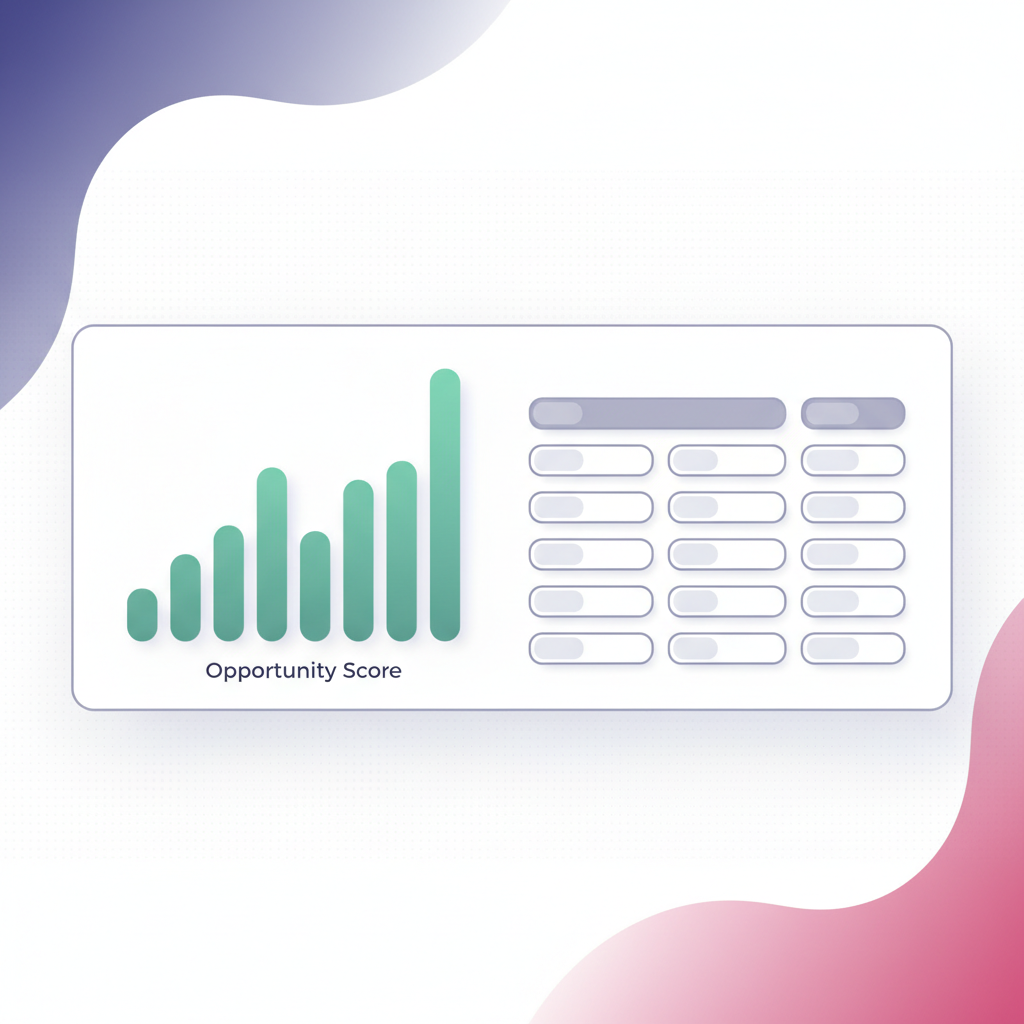
The scoring formula that actually works isn’t volume / KD. That over-rewards
unrealistic head terms. The honest formula is something like:
opportunity = log10(volume + 1) / log10(kd + 2) * relevance_to_brandThe log compression makes a 1,000-volume / KD-15 keyword score similarly to a 10,000-volume / KD-50 head term, which matches reality. The relevance multiplier kills keywords that don’t fit your brand niche even if the volume is high.
Tools that do this end-to-end include Ranket (DataForSEO + GSC + brand profile), BlogSEO (DataForSEO only), and Frase (different scoring model). For DIY, a Notion database fed by a Zapier workflow can substitute, but at the cost of speed and the relevance signal.
The output you want is a Quick Wins panel: keywords currently ranking on page 2 (positions 11–25) with meaningful impressions in your Search Console. These are the articles that move the needle in 30 days, not 12 months.
Stage 2: SEO strategy automation
Strategy is the layer between “we want to rank for X” and “here’s the brief.” Automated strategy reads the live SERP for the target keyword and decides:
- Format — listicle, how-to, guide, comparison, or definition. The wrong format guarantees no ranking, regardless of word count or backlinks.
- Target word count — usually competitor median + 500 to 800 words for a meaningful coverage gap
- Outline — eight to twelve H2 headings synthesizing what every top result covers plus genuine gaps
- Entities to cover — the specific concepts every top page mentions
- Selected sources — best YouTube video, best Reddit thread, two to three authority links pulled from the actual SERP (no hallucinated URLs)
This stage is where most pure-AI tools fail badly: they ask Claude to “write a 2,000 word article about X” without the SERP context. The result is generic — fine for volume but invisible in rankings. Automated strategy with real SERP scraping is what gets you on page one.
Stage 3: AI content writing automation
The writing stage is where most marketers’ attention goes — and where most overspend. A single-shot prompt to Claude or GPT produces text. A multi-stage pipeline produces content that ranks. The difference compounds.
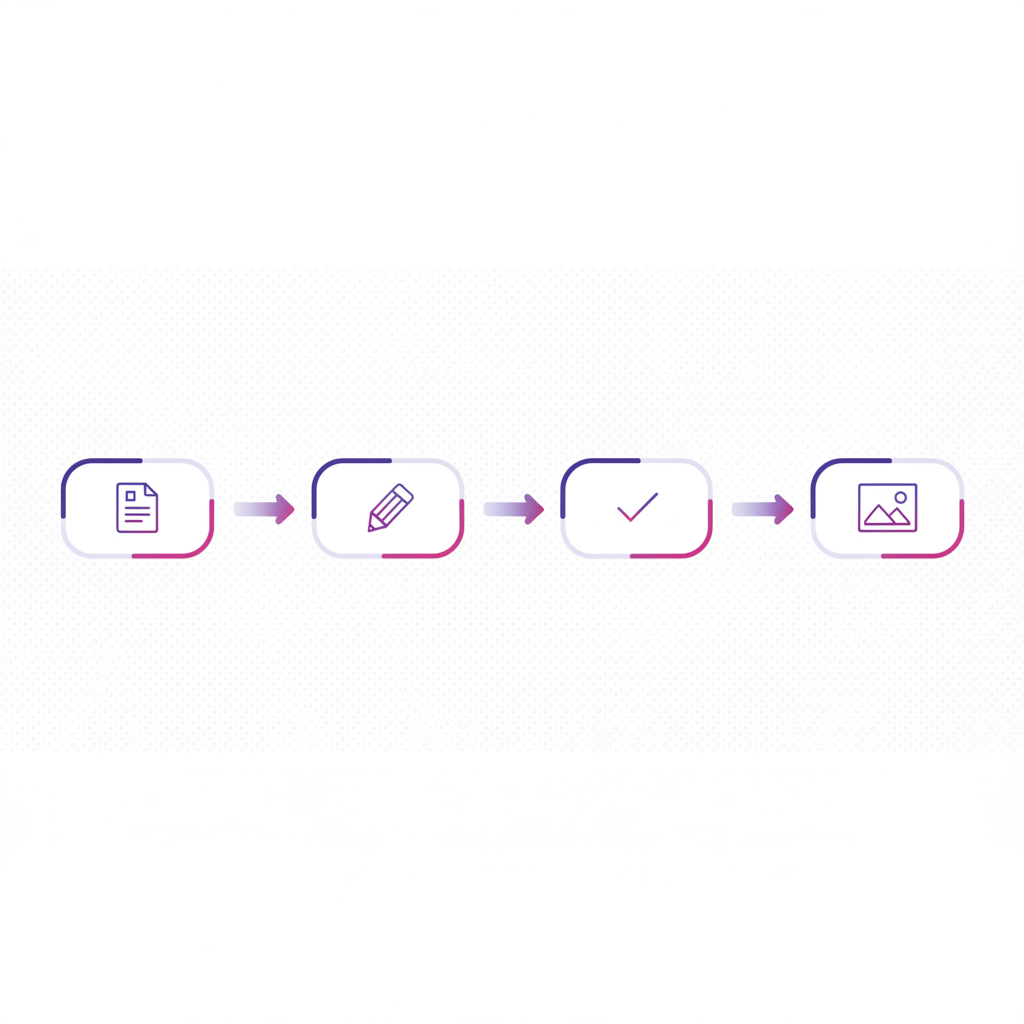
A working 2026 writing pipeline runs in four sub-stages:
- Brief — converts the strategy + SERP data into a per-section content map (angle, key points, target words, embed placement)
- Draft — writes the full article from the brief, with brand voice baked in, internal links inserted, embed placeholders honored
- Polish — critique-then-revise pass that removes AI tells, weak transitions, and vague claims
- Images — generates a hero image plus inline images via Fal or DALL-E, matched to brand visual style
A multi-stage Sonnet pipeline costs roughly €0.10 to €0.25 per 3,000-word article (with prompt caching). A single-shot Opus call for the same length costs around €0.45. The multi-stage version produces meaningfully better output at less than half the cost — counterintuitive but consistent in our testing.
The “doesn’t sound like AI” requirement is mostly a function of the polish stage, not the model. A Sonnet draft + a 200-token polish that explicitly hunts AI tells outranks an unedited Opus draft on every metric we measure.
If you want to handle this stage yourself, the cluster of tools that compete on quality includes Ranket, BlogSEO, and Outrank for full automation, or Surfer SEO and Frase for AI-assisted human writing. We compare each in the best SEO automation tools section below.
Stage 4: Auto-publishing to your CMS
This is the stage automation buyers most underestimate. Generating an article is useless if it sits in a draft folder waiting for someone to copy-paste it into WordPress.
There are two viable patterns in 2026:
Native plugins — the SEO automation tool installs a WordPress plugin (or Webflow integration, etc.) that pushes articles directly. Pros: zero customer effort. Cons: limited to whichever CMSes have a plugin; breaks when the host CMS changes its API.
Signed webhooks — the tool POSTs a JSON payload to a customer-controlled endpoint; the customer’s CMS receiver writes the post. Pros: works with any CMS, custom Next.js, or static-site generator. Cons: requires the customer to write a small receiver (usually 50 lines of code).
Ranket uses webhooks because the long tail of CMSes — Sanity, Framer, custom Astro, Contentful — never gets a maintained plugin. The webhook approach also lets us include both Markdown and pre-rendered HTML in the same payload, so most receivers need zero transformation.
Whichever pattern you pick, the contract should include: the article body (Markdown + HTML), full metadata (title, slug, meta description, JSON-LD), images (URLs to a CDN), FAQ items, and internal/external links. Half-payloads force manual cleanup and break the automation premise.
For idempotency, every delivery should carry an X-Delivery-ID header so retries
don’t double-publish. For security, sign the payload with HMAC-SHA256 — Stripe-style
header — and reject anything older than five minutes on the receiver.
Stage 5: Internal linking + backlink automation
Most AI content tools treat links as a manual job. A real automation pipeline handles two link types automatically:
Internal links — every new article should link to existing related articles, and existing articles should link to the new one. The pipeline needs the brand’s full sitemap with embeddings to pick semantically relevant targets and varied anchor texts. Done well, internal linking moves orphan pages and boosts new ones to page one in weeks rather than months.
External backlinks — the harder problem. Manual link building costs $300–$600 per placement. Automated exchange networks (where Brand A links to Brand B in exchange for a reciprocal placement, or routed via three-way exchanges) reduce this to roughly $1–$5 of compute cost per placement, with topical relevance enforced by embedding similarity.
The tradeoff is quality: automated exchanges only work inside well-defined niches, and Google penalizes obviously reciprocal patterns. The 2026 best-practice is embedding-matched contextual placements with a per-pair cap and an exact-anchor cap to avoid manipulative patterns. Ranket’s exchange uses cosine similarity on topic vectors with a minimum 0.55 threshold and at most three placements per source-target pair across any 90-day window.
If you don’t want to participate in an exchange network, automation still helps: batch-generating outreach emails personalized from each prospect’s recent posts is a realistic 2026 workflow. Tools like Pitchbox automate this at scale.
Stage 6: Measurement + optimization (the loop closer)
This is the stage that turns a content factory into a content system. Without it, you’re publishing into a void. With it, every article you ship makes every previous article more likely to rank.
The measurement stack is small and free:
- Google Search Console — query-level impressions, clicks, CTR, position
- PostHog or Plausible — pageviews, scroll depth, conversions per article
- Your own database — the article-level cost telemetry (input tokens, output tokens, total spend) so you can compare model choices
The data flows back into the optimization layer, which makes three decisions on a weekly schedule per article:
- Is this article ≥14 days old AND has it received ≥100 impressions or some PostHog traffic? (eligibility gate)
- If yes, is its average position 5–20 with low CTR? Or is its scroll depth poor? Or is it getting impressions for queries it doesn’t actually mention? (decision)
- If yes, what specifically should we rewrite — title, intro, missing section, CTA? (action)
The optimization runner produces a JSON patch — surgical edits to specific sections,
preserving schema, FAQ, internal links, and images — applies it to the article, and
fires an article.updated webhook to your CMS so it can re-publish.
This is the loop closure. Every article that ranks reinforces the network; every article that stalls gets surgical repair. After three cycles, the worst-performing articles get a “skip” verdict from the agent (the data confirms they won’t rank regardless of rewrites) and you save the compute.
What SEO automation actually costs in 2026
Three honest cost models, all assuming a 30-articles-per-month cadence for a single brand:
Budget setup (Haiku, no caching, no premium polish)
- Research: ~€0.50/mo (DataForSEO API for 30 keywords)
- Writing: ~€0.05 × 30 = €1.50/mo
- Publishing: free (webhook)
- Measurement: free (GSC + PostHog free tier)
- Optimization: ~€0.02 × 10 articles/mo = €0.20/mo
- Total: ~€2.20/mo in API costs
Production setup (Sonnet with caching, light polish)
- Research: €0.50/mo
- Writing: ~€0.30 × 30 = €9/mo
- Publishing: free
- Measurement: PostHog Pro at $30/mo if you exceed free tier, otherwise free
- Optimization: €0.05 × 15 articles/mo = €0.75/mo
- Total: ~€10/mo in API costs (€40/mo with PostHog)
Premium setup (Opus on draft + Sonnet on rest, full polish + critique)
- Research: €0.50/mo
- Writing: ~€1.00 × 30 = €30/mo
- Publishing: free
- Measurement: PostHog Pro $30/mo
- Optimization: €0.10 × 15 articles/mo = €1.50/mo
- Total: ~€60/mo in API costs (€90/mo with PostHog)
These numbers are the raw costs. Tools that handle the orchestration (Ranket, BlogSEO, Outrank) charge €49–€199/mo for the same workload — that markup pays for the engineering, the matcher network, the optimizer logic, and the absence of you having to glue 12 services together with bash.
For comparison: a freelance SEO writer charges $150–$400 per article. At 30 articles/month that’s $4,500–$12,000/month. Automated stacks deliver roughly 95% of the quality at 1–2% of the cost.

Best SEO automation tools in 2026
Quick comparison of the seven tools that ship genuine automation across multiple stages. For deeper LLM-specific comparisons, see our best LLM SEO tools and GEO tools guides.
- Ranket — €49–€99/mo. Full pipeline with optimization agent, GEO/AEO by default, signed webhooks for any CMS. Strongest cost-per-article telemetry.
- BlogSEO — $97/mo. Single plan, automatic publishing, ABC backlink exchange. Good fit if you want one fixed price and built-in backlinks.
- Outrank — $79+/mo. Solid auto-publishing, weaker measurement integration.
- Launchmind — €275–€1,399/mo. Done-for-you service with founder interview process. See Ranket vs Launchmind for the comparison.
- Surfer SEO — $89+/mo. Best-in-class SERP analysis but no end-to-end automation — it’s an editor, not a pipeline. See Ranket vs Surfer SEO.
- Frase — $45+/mo. Strong briefs, weaker on the writing and zero on publishing. See Ranket vs Frase.
- Writesonic — $20+/mo. Cheapest tier, but lacks SERP-aware strategy and real publishing automation. Best for content volume in low-stakes niches.
The honest read is that no tool yet automates every stage flawlessly. Ranket covers the most surface (research → write → publish → optimize → backlinks) at the lowest entry tier. If you have a writing team you want to keep, Surfer + a manual publishing workflow is still defensible.
For a counterpoint to vendor marketing, the r/DigitalMarketing post I tested 15+ AI SEO tools — here are the only ones worth using and the r/TechSEO thread on best AI-powered SEO content optimizers collect first-hand reviews — worth scanning before committing to any tool above.
What you should NOT automate (yet)
Three things 2026 automation still does poorly:
- Money pages — your homepage, pricing page, and category landing pages should stay human-written. The conversion-rate math doesn’t justify the time saved.
- Sensitive verticals — medical, legal, financial. The E-E-A-T penalty for AI-flavored content here is real, and the legal risk is non-zero.
- Competitive head terms — the top 10 keywords driving 50% of your category’s traffic are worth a human writer’s full attention. Use automation for the long tail; use humans for the moats.
For everything else — informational content, tutorials, comparison pages, programmatic listicles — full automation outperforms human writing on cost and matches or beats it on ranking outcomes after 90 days.
How long until automated SEO shows ROI
Honest timelines, assuming a domain with at least minimal authority (DR 10+):
- Week 1–2 — first articles published, indexed by Google
- Week 3–6 — initial impressions in Search Console, first ranking positions appear (typically positions 30–60)
- Week 6–12 — Quick Wins start hitting page two, optimization agent starts surgical rewrites on stalled articles
- Month 3–6 — first articles hit page one, traffic compounds, internal links start carrying weight to newly published pieces
- Month 6+ — stable monthly content output produces predictable monthly traffic growth, optimization loop reduces churn on previously-published articles
Brand-new domains (DR 0–5) take roughly 2x longer because Google sandboxes new sites. The fix is parallel work on backlinks and brand mentions in the first 90 days — automation can’t compress this.
Common SEO automation mistakes
Five things we see in customer post-mortems often:
- Buying a writer-only tool and expecting it to replace publishing + measurement
- Skipping Search Console connection — the measurement loop fails without it
- Setting too aggressive a cadence on a new domain — 30 articles/month from a DR 0 site looks spammy and gets sandboxed
- Ignoring brand voice setup — without scraping your existing site for tone, the AI defaults to generic SaaS voice
- Not running the optimization loop — the cheapest 10x improvement is rewriting underperformers, but it requires connecting GSC and PostHog
SEO automation FAQ
Is SEO automation different from AI SEO?
Yes, but with overlap. AI SEO usually means using AI tools to assist a human writer — Surfer, Frase, ChatGPT prompts. SEO automation means running the full research → write → publish → optimize loop with minimal human involvement. Most AI SEO tools handle one or two stages; automation tools handle all six.
Can you fully automate SEO end-to-end?
Yes, for informational and long-tail content. Tools like Ranket, BlogSEO, and Outrank ship articles to production CMSes daily without human review. For money pages, sensitive verticals, and head terms, partial automation (research + strategy + brief, with a human writer) still wins.
What does SEO automation cost?
Raw API costs run €2 to €60 per month for 30 articles depending on model tier. Hosted automation tools charge €49 to €199/mo for the same workload. Either way, it’s 1–3% of the cost of a freelance writer producing the same volume.
Will Google penalize automated SEO content?
Google’s policy explicitly allows AI-generated content as long as it’s helpful. The Helpful Content Update penalizes thin, unoriginal, or unhelpful content regardless of whether a human or AI wrote it. A multi-stage pipeline with SERP-grounded strategy, real schema, and unique angles passes the same bar a human writer does. The r/SEO thread Is AI-generated content ranked on Google? collects representative practitioner reports — both wins and penalties.
What parts of SEO should you NOT automate?
Money pages (homepage, pricing, key landing pages), sensitive verticals (medical, legal, financial advice), and the top 10 head-term keywords in your category. The conversion-rate math doesn’t justify automation here, and the E-E-A-T penalty for sensitive verticals is real.
What’s the best SEO automation tool for solo founders?
For solo founders publishing 15–30 articles per month, Ranket’s Starter or Pro plan at €49–€99 covers the full pipeline including optimization and backlinks. BlogSEO at $97 is the closest competitor with a single fixed price and built-in ABC exchange.
Best SEO automation software for agencies?
Agencies need multi-brand support and white-label. Launchmind’s done-for-you model fits agencies that want service revenue. Ranket’s API + multi-brand pricing fits agencies wanting to embed automation into their client workflow without exposing the underlying tool.
How long until automated SEO shows ROI?
For DR 10+ domains, expect first impressions at 3–6 weeks, first page-one rankings at 3–6 months, and predictable monthly traffic growth from month 6 onward. DR 0–5 domains take roughly 2x longer because of Google’s new-site sandbox.