If you’ve Googled programmatic SEO in 2026, you’ve probably seen the famous case studies — Zapier integration pages, Wise currency pairs, Nomad List remote-work profiles — and wondered how to do the same. This is the playbook. We build Ranket, one of the AI-native programmatic SEO tools, so the parts where the approach genuinely fails get the honest treatment.
TL;DR: Programmatic SEO works when you have (1) a scalable template that matches real search intent, (2) a unique data source nobody else has, and (3) enough per-page quality to clear Google’s helpful-content bar. Skip if you don’t have all three. Read the 4 ingredients, the step-by-step playbook, or the FAQ.

What programmatic SEO is (and isn’t)
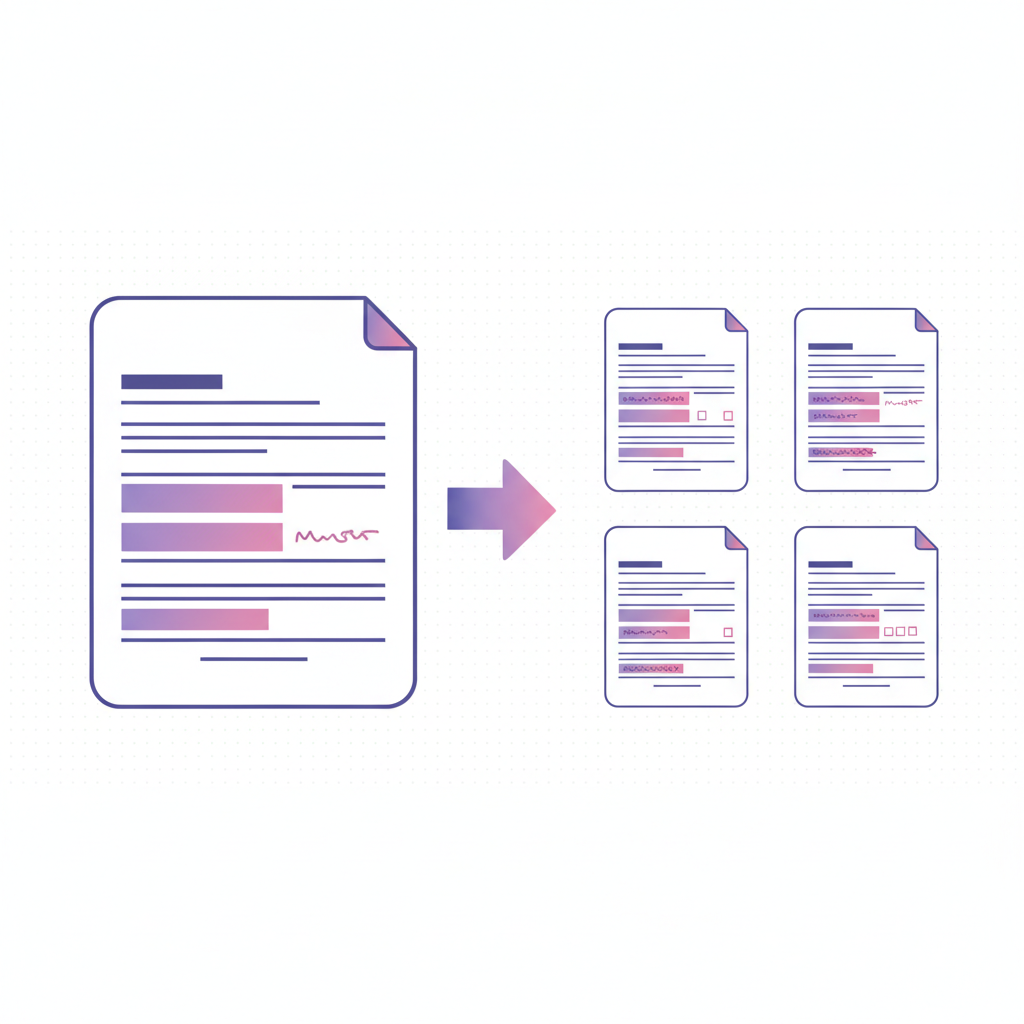
Programmatic SEO is the practice of generating many pages from a single template by
varying input data — [city] [service], [product] vs [competitor], best [tool] for [use case]. One template + a CSV of variables = hundreds or thousands of
ranking pages.
What it isn’t:
- Content farming — auto-spun word salad with no unique data
- AI mass generation — 1,000 generic AI-written articles on adjacent topics
- Doorway pages — pages that exist only to redirect users elsewhere
The difference between programmatic SEO that ranks and content farming that gets penalized is unique data per page. Zapier’s integration pages rank because each page has unique data about a specific integration — what it does, the trigger events, the action steps, the apps involved. A page that’s just “ChatGPT integration with Slack” with three sentences of generic copy is content farming. The same template with 50 unique data points per integration is programmatic SEO.
The category overlaps with SEO automation and AI for SEO, but it’s a distinct discipline. SEO automation is about running the writing pipeline. Programmatic SEO is about the template + data model that scales one piece of work into many ranking pages.
The 4 ingredients of a programmatic SEO page that ranks
Every successful programmatic SEO project has all four. Missing any one kills the project.
- A template that matches real search intent —
[X] vs [Y]only works because comparison-shopping is a real intent.Best [X] for [Y]works because “what should I buy” is a real intent. Made-up templates with no underlying intent don’t rank. - A unique data source — what makes each page different from every other page. Public datasets count. Scraped data counts. Internal usage data counts. AI-generated speculation does not.
- A quality floor per page — minimum 300–500 words of genuinely unique content, not just data table + filler. The “helpful content” bar applies even to programmatic pages.
- Internal-link structure — pages need to link to each other in a hub-and-spoke pattern. Without it, Google sees orphan pages and deindexes most of them.
The most common failure mode: a great template with no unique data per page, producing pages that look identical to a Google quality rater and get either deindexed or never indexed at all.
Real examples that actually work
The five most-cited programmatic SEO case studies and what they got right:
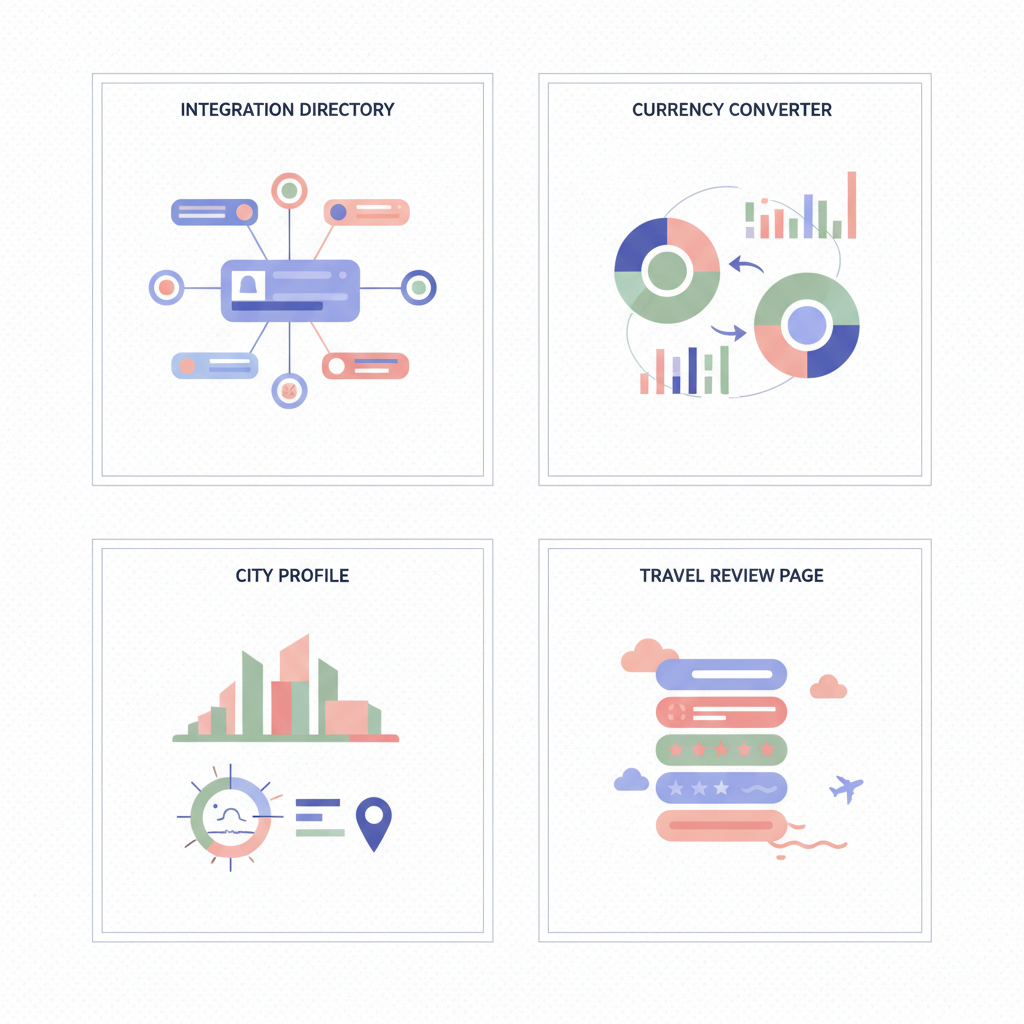
Zapier — Integration pages
Template: [App A] + [App B] integration. Data per page: trigger events, action
steps, supported plans, popular use cases pulled from internal API metadata. Each
page is unique because the underlying integration is unique. Roughly 15,000+ pages
ranking, driving the majority of Zapier’s organic traffic.
Wise (formerly TransferWise) — Currency pair pages
Template: [Currency A] to [Currency B] exchange rate. Data per page: live exchange
rate, historical chart, fees, transfer time, comparison vs banks. Hundreds of
unique currency pair pages ranking on intent-loaded queries that traditional banks
ignored.
Nomad List — City profiles
Template: city pages with cost-of-living, internet speed, weather, visa rules, nomad community size. Each page has dozens of unique data points scraped or crowd-sourced. Roughly 1,300 city pages ranking for “[city] for digital nomads” queries.
Tripadvisor — Neighborhood pages
Template: Things to do in [Neighborhood] [City]. Data: hotels, restaurants,
attractions, all geo-tagged. Tens of thousands of pages built on UGC + Google Maps
data.
G2 / Capterra — Software comparison pages
Template: [Tool A] vs [Tool B] and Best [category] software. Data: user reviews,
feature comparisons, pricing, screenshots. Each page sits on a meaningful pile of
unique reviews.
The common pattern: structured data nobody else has, served against a template that matches a real recurring search intent.
Beyond the famous case studies, smaller wins surface in founder communities all the time — see r/SaaS’s I finally did programmatic SEO for my SaaS and got 10K new visitors for a recent first-person walkthrough at a smaller scale.
The 5-step programmatic SEO playbook
The end-to-end workflow, in order:
- Find a scalable template
- Source structured data
- Generate the pages without thin content
- Build the internal-link structure
- Submit + monitor indexing
We’ll walk each step with concrete tactics. If you’d rather start from a community-vetted overview, the r/SEO thread How to do programmatic SEO properly? covers the same five-step shape with practitioner commentary.
Step 1: Find a scalable template
The good templates fall into five families:
- Comparison —
[X] vs [Y],[X] alternatives,Best [X] for [Y] - Listicle —
Top 10 [X] in [Y],Best [X] under $[price] - Location —
[Service] in [City],[Tool] for [Country] - How-to specific —
How to [verb] in [tool],How to [verb] [object] - Glossary / definition —
What is [X]?,[X] meaning
To pick a template, ask three questions:
- Is there real recurring search volume on the pattern? (Use DataForSEO’s keyword suggestions — search for the template with placeholders filled in)
- Do you have a unique data source for the variable axis?
- Can you produce 300+ words of unique content per page from that data?
If you can’t answer yes to all three, the template doesn’t work programmatically. You’ll get cleaner ROI writing 30 manual articles instead.
The DataForSEO check we use ourselves: [primary verb/noun] [variable] returns
keyword variations with volume. If the average variation has ≥30 monthly searches
and KD is below 25, the template is viable. Below 30/month average, you’re chasing
zero-volume tail.
Step 2: Source structured data
This is where most programmatic SEO projects die quietly. Options for data sourcing, ranked by quality:
- Internal API data — strongest moat. Zapier’s integrations, Notion’s templates, GitHub’s repos. You have it; nobody else does.
- Public APIs — exchange rates (Wise), weather, sports stats, government databases
- Scraped public data — restaurant reviews, real estate listings, product catalogs. Legal grey area; check ToS.
- AI-generated synthetic data — last resort. Often legitimate (e.g., AI-generated recipe variations from a base recipe library), often spam (AI-imagined statistics).
The non-negotiable rule: the data must be true, fact-checkable, and at least partially unique to your page. “Restaurants in Brooklyn that serve dim sum” is fact-checkable. “Things to do in Brooklyn that nobody knows about” is not (and won’t survive Google’s quality bar).
For data acquisition, the indie-friendly stack: Airtable or a Postgres table for storage, a daily cron to refresh from the source, a JSON export to feed the generation pipeline.
Step 3: Generate the pages without thin content
The hardest engineering step. The output per page needs:
- Unique title + meta description —
[App A] + [App B] integrationworks as a title pattern, but the description needs unique data (“Connects [trigger] in [App A] to [action] in [App B]”) - Unique opening paragraph — generated from the data row, not a template
- Multiple unique data sections — table, list, chart, whatever — but each one populated with row-specific values
- Unique FAQ section — questions and answers generated from the row data
- Unique internal links — pages link to other pages in the same cluster, with variable anchor text
The minimum unique-content threshold we measure against: at least 60% of the page’s text must be unique to that row. Below that, Google deindexes most of the batch within 90 days.
The 2026 generation stack:
- Spreadsheet/database with one row per page
- Template engine (Astro, Next.js, Eleventy, or a CSV-to-Markdown tool like Whalesync)
- AI assist for the unique-content sections — Claude or GPT to generate the 3–5 sentences of intro, the FAQ answers, and the section commentary from the row data
Tools that handle the AI-assist part natively: Ranket (with the programmatic-batch mode on the Pro plan), Whalesync (Notion + Webflow integration), Webstudio (visual builder with CMS), or DIY with Astro + your own CSV ingestion.
For pure scale (10,000+ pages), Astro’s content collections + a scheduled regeneration job is the cleanest setup. For smaller projects (200–500 pages), Webflow CMS or Notion + Whalesync is faster.
Step 4: Internal linking the cluster
Programmatic pages are usually orphans by default — nobody links to them externally. The fix is aggressive internal linking in a hub-and-spoke pattern:
- Hub page — a category landing page that links to every page in the cluster.
Example: Zapier’s
/appspage links to every individual integration. - Spoke pages — every individual programmatic page links back to the hub and to 3–5 related programmatic pages
- Related-page logic — for
Notion + Slack integration, link toNotion + Discord integrationandAsana + Slack integration(one variable shared) - Cross-link from your blog — each of your written articles should link to the hub page and to 1–2 highly relevant spoke pages
Without this structure, Google sees a flat dump of pages and indexes maybe 10% of them. With it, the entire cluster gets indexed and starts driving compound traffic within 60–90 days.
The anchor text rule: vary it. Don’t link to every Notion integration page with the anchor “Notion integrations.” Mix in the specific integration name, the parent app name, and natural-language anchors. Google penalizes monotone anchor patterns.
Step 5: Submit + monitor indexing
The final step most teams forget. With 1,000+ new pages, you need to:
- Split your sitemap — Google’s sitemap limit is 50,000 URLs per file. Split
into themed sub-sitemaps (
/sitemap-integrations.xml,/sitemap-cities.xml) with a sitemap index pointing to each. - Submit to GSC — submit each sub-sitemap individually so you can monitor indexing per cluster.
- Watch the Indexed pages report — if Google indexes fewer than 50% of the batch within 90 days, the unindexed pages are too thin. Go back to Step 3.
- Deindex thin pages fast — if a sub-cluster underperforms, no-index it. Don’t let it drag down the rest.
- Use the Indexing API — for time-sensitive content (events, jobs, livestreams) you can ping Google directly. For general programmatic content, the Indexing API isn’t officially supported but sometimes works.
The first 30 days post-submission are the “did it work” window. By day 30 you should see most pages crawled and 30%+ indexed. By day 90 you want 70%+ indexed with the first ranking impressions starting to appear.
Programmatic SEO tools compared
Quick comparison of the seven tools that actually ship programmatic SEO workflows in 2026:
- Ranket — €49–€99/mo. AI-native with programmatic batches up to 200 pages on the Pro plan, full content quality + on-page automation, optimization agent for stalled pages.
- Whalesync — €30+/mo. Notion + Webflow / Airtable + Webflow sync. Strong if you want CMS control and don’t need AI.
- Webstudio — Free + paid. Visual builder with CMS. Good for non-engineers building under 500-page programmatic clusters.
- Webflow CMS — From $14/mo. Native CMS with collection pages. Hits a scalability wall around 10,000 pages.
- Astro / Next.js + custom code — Free, but engineering-heavy. Best for 10,000+ page clusters or unique data structures.
- Frase — $45+/mo. Bulk-creation but not truly programmatic.
- Page Generator Pro (WordPress plugin) — $49+/mo. Old-school programmatic on WordPress. Works but feels dated.
The honest pick depends on volume and skill: Ranket for AI + automation, Astro for engineering teams, Whalesync for Webflow-first workflows.
Common programmatic SEO mistakes
The five patterns that kill programmatic SEO projects:
- Thin pages — duplicate content with one variable substituted. Google deindexes within 90 days.
- No unique data source — generic AI fluff per page is the canonical bad pattern
- Skipping internal linking — pages stay orphaned and unindexed
- Bad sitemap structure — one massive sitemap file vs. themed sub-sitemaps
- Not monitoring indexing — by the time you notice 80% of the batch isn’t indexed, it’s been 6 months
- Building before validating — generating 5,000 pages on a template Google doesn’t respect, then having to no-index all of them
The validation-first pattern: build 50 pages, submit them, wait 60 days. If 70%+ get indexed and start ranking, scale to 5,000. If not, fix the template or the data quality before scaling.
The other side of the trade lives in posts like r/SEO_Experts’ Programmatic SEO site lost 90% traffic overnight and r/Agentic_SEO’s Programmatic SEO is just noise based on my last 5 years — worth reading before scaling past the 50-page validation batch.
What programmatic SEO costs (with real numbers)
Costs depend more on data acquisition than on page generation in 2026. The page generation itself is cheap — AI-assisted unique content for 1,000 pages runs roughly €30–€80 in API costs at Sonnet-tier quality. The expensive part is sourcing the data:
- Internal API data (free) — strongest moat, costs you nothing if you have it
- Public APIs (free to ~$50/mo) — Wise, exchange rates, government datasets, weather, sports stats
- Scraped public data (€100–€2,000) — proxy services, scraping infrastructure, legal review
- Licensed third-party data (€500–€10,000/mo) — industry datasets, market research, financial data
- AI-generated synthetic data (€20–€100) — rarely the right answer; almost always crosses the line into thin content
For a 1,000-page programmatic project with public-API data and AI-assisted unique content per page, total launch cost lands between €80 and €500 — including Ranket Pro plan plus the data subscription. Compared to a manually-written equivalent (1,000 pages × $150 freelance writer = $150,000), the cost differential is roughly 300x. The quality differential is roughly 20% in Google’s favor of the freelancer — but with proper template + unique data, that gap closes within 90 days of optimization.
How long until programmatic SEO shows results
Honest timelines, assuming a domain with at least minimal authority (DR 10+):
- Week 1–2 — pages crawled by Google, sitemap fully ingested
- Week 3–8 — first 30–50% of pages indexed, initial rankings appear at positions 30–60
- Month 2–4 — indexing rate climbs to 70%+, first pages hit page two
- Month 4–6 — meaningful traffic from the cluster (10K+ visits/mo for a 500-page cluster on a viable template)
- Month 6+ — compound traffic growth as more pages mature into page-one rankings
DR 0–5 sites take roughly 2x longer because of Google’s new-site sandbox. Programmatic SEO on brand-new domains is mostly a waste — build authority with manual content first.
Programmatic SEO FAQ
Will Google penalize programmatic SEO pages?
Only if they’re thin or unhelpful. Google’s stance is consistent: AI-generated or programmatically-generated content is allowed as long as it’s helpful. Pages with at least 60% unique content per row, real underlying data, and proper internal linking pass the same bar a human-written page does.
What’s the minimum unique content per page?
Empirically, at least 60% of the page’s text must be unique to that row. Anything less and Google deindexes most of the batch within 90 days. The 60% bar includes the unique opening paragraph, FAQ answers, and section commentary generated from the row data.
How do you source data for programmatic SEO?
The hierarchy: internal API data (strongest moat), public APIs (good), scraped public data (legal grey area, check ToS), AI-generated synthetic data (last resort, often spam). The non-negotiable rule is the data must be true, fact-checkable, and at least partially unique to your page.
Best programmatic SEO tool for solo founders?
For solo founders, Ranket’s Pro plan at €99/mo includes programmatic batches of up to 200 pages with AI-generated unique content per row. Whalesync at €30/mo is cheaper but requires you to bring your own data + CMS. Astro + custom code is free but engineering-heavy.
How long until programmatic pages rank?
For DR 10+ sites: most pages indexed within 60 days, first ranking impressions at 60–90 days, meaningful traffic from month 4–6. New domains take roughly 2x longer because of Google’s sandbox.
Is programmatic SEO the same as content farming?
No. Content farming is auto-spinning generic word-salad with no unique data per page. Programmatic SEO is structured data + a template, where each page has genuine unique content from the data. The difference is whether you have a real underlying data source per page.
Can I do programmatic SEO with AI?
Yes — AI is genuinely useful for the per-row unique-content generation (opening paragraph, FAQ answers, section commentary). It’s NOT useful for generating the underlying data — that has to be real and verifiable. Tools like Ranket combine both: AI for the prose, your data source for the substance.
How many pages should I generate for one cluster?
Validate with 50 pages first. If 70%+ get indexed within 90 days and start ranking, scale up. The natural ceiling is whatever your data source supports — Zapier has thousands of integrations, so thousands of pages. A 50-city service business has 50 pages. Don’t manufacture artificial volume; match the data.