If you’ve Googled SaaS SEO in 2026, you’ve already noticed the same thing every other founder has: generic SEO advice doesn’t translate. SaaS buyers don’t search like consumers. They compare. They evaluate. They use ChatGPT before they ever visit your site. The 2026 SaaS SEO playbook is structurally different from the e-commerce or local-business playbooks. This is the guide. We build Ranket, an AI SEO automation tool used by B2B SaaS founders, so the parts that actually move pipeline get the honest treatment.
TL;DR: SaaS SEO in 2026 is comparison content + programmatic landing pages + AI search optimization, in roughly that order of priority. Long-form blog content matters but ranks slower than comparison pages. Skip to the 7-step framework, comparison content strategy, or the FAQ.
What makes SaaS SEO different from regular SEO
Three structural differences that change the entire playbook:
- Longer buying cycle, deeper research — B2B SaaS buyers spend 6–14 weeks evaluating before purchase. That’s 20+ touchpoints with your content, not 1.
- Comparison-first intent — the highest-converting SaaS searches are comparison and alternative queries: “Tool A vs Tool B”, “Tool A alternatives”, “Best [category] for [use case]”. These dwarf head-term ranking in commercial value.
- AI-search dominates pre-purchase research — 50%+ of B2B buyers now ask ChatGPT, Claude, or Perplexity before visiting product websites. If LLMs don’t cite you, you’re invisible to that early-stage research.
Generic SEO advice (“rank for your category head term, write blog posts”) underestimates the first two and ignores the third. SaaS SEO in 2026 inverts the priority: comparison content first, programmatic pages second, blog content third, AI-search structuring across all of it.
The category overlaps with our broader work on SEO automation and AI for SEO, but it’s a distinct discipline.
Why generic SEO advice fails B2B SaaS
Common SaaS SEO mistakes that come from applying e-commerce/blog playbooks:
- Chasing head terms first — “best CRM” has volume but takes 18+ months to rank for a new domain. Long-tail comparison terms (“best CRM for B2B startups under 50 employees”) rank in 60 days.
- Skipping comparison pages — comparison searches convert at 5–10x the rate of generic informational searches. SaaS teams over-invest in blog posts, under-invest in /vs and /alternatives pages.
- Ignoring ChatGPT/Perplexity — your customer’s CFO asks Perplexity “what’s the best [your category] tool” before they ever visit your site. If LLMs don’t surface you, the sale is over before it started.
- No vertical/use-case landing pages — “CRM for SaaS startups” is different intent from “CRM for enterprise sales teams”. One landing page per (vertical × use-case) ranks faster than one giant homepage.
Each of these is a structural fix, not a content quality issue. The blog posts can be excellent; if the strategy below them is wrong, traffic doesn’t convert.
The 7-step SaaS SEO framework
A working 2026 SaaS SEO playbook in order of ROI:
- Comparison content — /vs/ pages for every direct competitor
- Alternative pages — /alternatives/[competitor] pages for indirect intent
- Use-case landing pages — vertical and persona-specific pages
- Programmatic SEO — integration pages, template pages, data-driven
- Long-form blog content — pillar + cluster strategy
- AI search optimization — schema, entity clarity, direct answers
- Backlink + brand authority — the long-game compounding signal
Steps 1–4 are direct revenue drivers (BOFU and MOFU intent). Steps 5–7 are authority and category-defining (TOFU + brand). The mistake most SaaS teams make: starting with step 5 because it feels like “SEO work”. The actual ranking ROI is in steps 1–4.
Comparison content — the BOFU workhorse
The single highest-converting SEO play for B2B SaaS in 2026:
Build a /vs/[competitor] page for every direct competitor. The pattern
is well-established: an honest side-by-side comparison, feature-by-feature,
with a structured table and a “which should you pick” framework.
Why it converts so well:
- People searching “Tool A vs Tool B” are in active evaluation. The conversion rate to demo/trial is typically 5–15% — vs 0.5–2% for informational blog content.
- You don’t need to be the largest brand to rank. KD on comparison terms is usually 5–15, vastly easier than head terms.
- The pages compound: once you have 5+ comparison pages, internal linking between them creates a topical cluster.
What makes a comparison page rank:
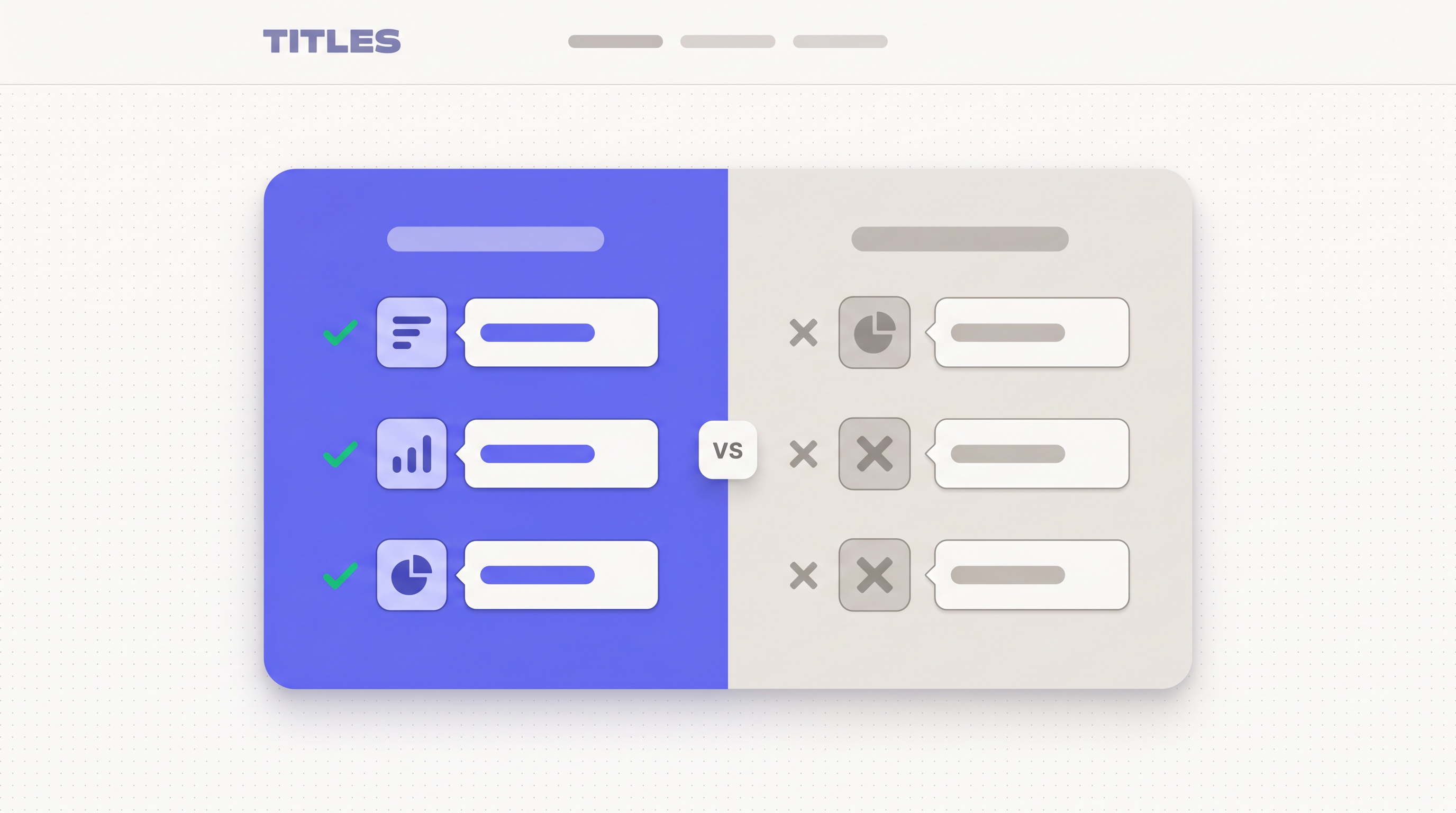
- Honest about competitor strengths — Google penalizes obviously one-sided “competitor X sucks, we win” content. Lead with what your competitor does well, then make your case.
- Structured comparison table — feature-by-feature, with checkmarks, ranges, or text values. Google AI Overview and Perplexity lift these verbatim.
- Clear “which should you pick” framework — explicit decision criteria. Don’t hide behind “it depends” — pick clear use cases for each tool.
- Updated annually — comparison content goes stale as competitors change pricing/features. Refresh every 12 months.
Our own example: Ranket vs SurferSEO follows this pattern. The build-time cost was ~30 minutes (data is in a shared template); the ranking + conversion impact is far higher than any single blog post.
Alternative pages — the underused capture pattern
Adjacent to comparison content but distinct: /[competitor]-alternatives
pages. These capture searchers actively evaluating leaving a current tool.
The intent signal is even stronger than comparison search. Someone typing “HubSpot alternatives” is unhappy with HubSpot and shopping. Conversion rates land 8–20%.
What makes alternative pages work:
- List 5–10 real alternatives, not just yourself. Honest framing.
- Honest about why someone might switch — pricing, complexity, missing features. Don’t lead with “HubSpot is bad.”
- Position yourself as one of several legitimate options, with a clear “best for” use case
- Internal-link to your own comparison pages with each competitor
For a new SaaS in a crowded category, alternative pages are usually the fastest path to commercial-intent rankings. KD on “[competitor] alternatives” terms is typically 10–25.
Use-case + vertical landing pages
The next-tier SaaS SEO play: per-persona, per-vertical landing pages.
Examples that work:
- “CRM for B2B SaaS startups”
- “Project management for remote design agencies”
- “Email marketing for ecommerce subscription brands”
- “Analytics for healthcare SaaS”
Each page targets a long-tail commercial query, ranks faster than the head term, and converts higher because the messaging resonates with exactly that audience.
The structure that ranks:
- H1 with the target keyword exact-match
- Hero promising the specific outcome for that vertical/persona
- 3–5 vertical-specific use cases or pain points
- Social proof from that vertical (customer logos, testimonials)
- Vertical-specific pricing/plan callout if applicable
- CTA tailored to the vertical’s buying motion (self-serve vs. demo)
For most SaaS, 5–10 use-case pages is the right shape. More than 10 dilutes the brand. The pages should share a base template but vary copy, social proof, and CTA per page.
Programmatic SEO for SaaS
Where SaaS programmatic SEO usually wins: integration pages, template/recipe pages, and data-driven calculators.
Real SaaS programmatic SEO examples:
- Zapier integration pages —
[App A] + [App B] integration. ~15,000 pages, drives most of Zapier’s organic traffic. - Notion templates —
[Use case] Notion template. Thousands of searches for “free Notion templates for [niche]”. - Calculator pages — Buffer’s free LinkedIn analytics, Wise’s exchange rate calculator. Free utility = recurring brand exposure.
- Comparison matrices — G2’s tool-category pages with feature comparisons across all vendors.
What makes SaaS programmatic SEO different from e-commerce programmatic:
- Need genuine utility per page — empty integration pages get deindexed fast. Real per-integration data (trigger events, action steps, popular workflows) is required.
- Internal data is the strongest moat — your own user behavior, API metadata, internal usage stats are unfakeable.
- The pages should lead somewhere — every programmatic page needs a CTA back to the product, often vertical-specific.
We cover the full methodology in our programmatic SEO guide. For SaaS specifically, integration pages are usually the highest-ROI starting point.
Long-form blog content for SaaS
This is where most SaaS teams over-invest. Long-form blog content matters, but ranks slower than comparison/programmatic content and converts lower per visit.
The right SaaS blog strategy:
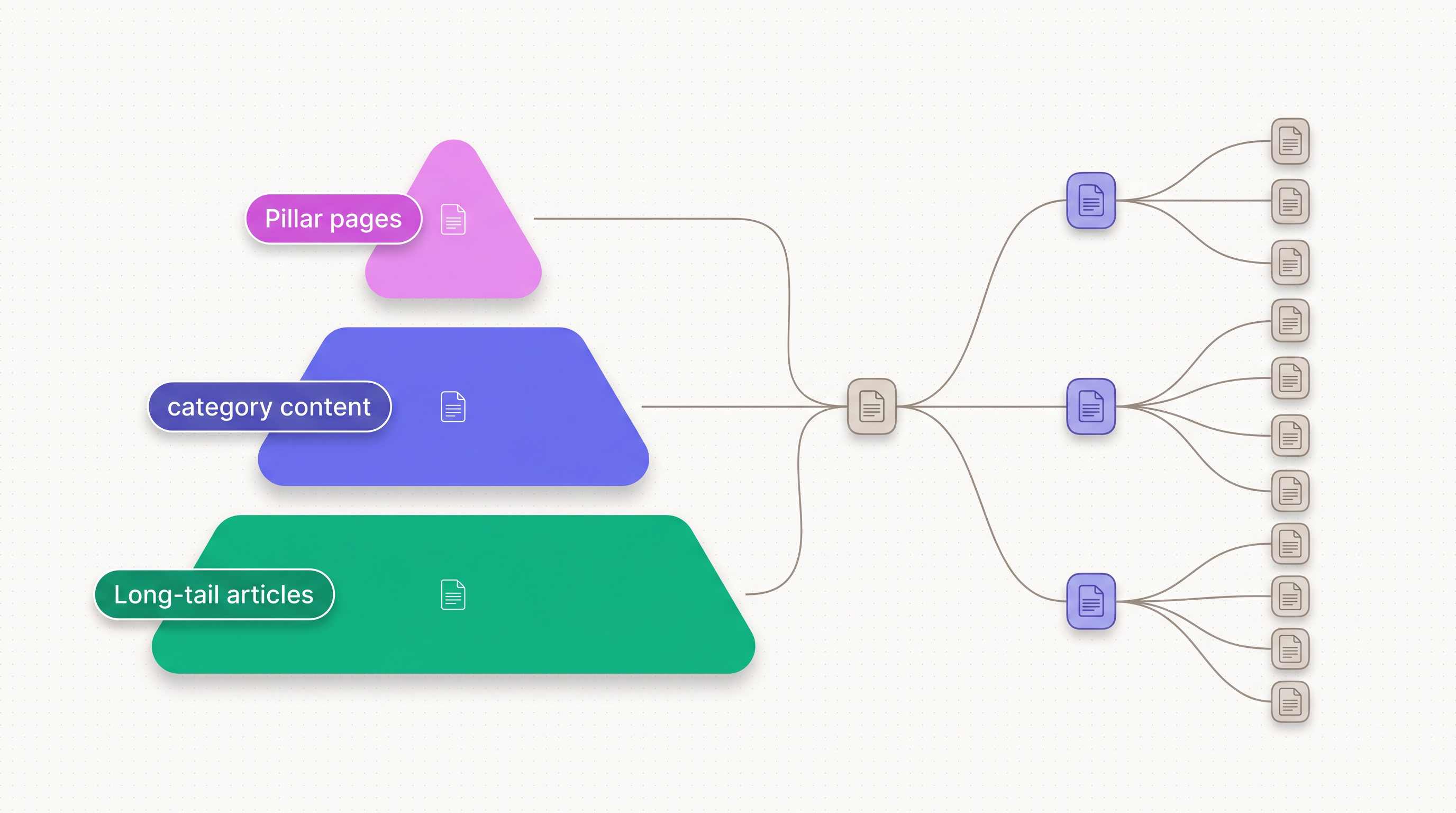
- Pillar + cluster structure — one pillar page per topic, 5–8 spokes per pillar. Builds topical authority.
- Buyer-aware content, not awareness-only — every blog post should speak to a specific stage of the buying cycle, with a CTA matching that stage.
- Comparison content cross-link — blog posts should link to comparison and alternative pages, not just other blog posts.
- Use case examples from real customers — “X solves [problem]” outranks “what is X” for SaaS buyers who’ve already crossed the awareness stage.
The cadence that works: 2–4 high-quality long-form posts per month, not 30 thin posts. SaaS buyers detect AI-flavored fluff faster than consumer audiences — quality bar is higher.
Tools that automate this without the AI-tells: Ranket with multi-stage pipeline and brand voice training, or Surfer/Frase for human-edited AI assistance.
AI search optimization for SaaS
The newest stage and arguably the most important for SaaS in 2026. B2B SaaS buyers heavily use ChatGPT, Claude, and Perplexity for pre-purchase research:
- “What’s the best [your category] tool for [their use case]”
- “Compare [your competitor] alternatives”
- “Is [your tool] worth it for [their use case]”
If LLMs don’t cite your brand in these answers, you’re invisible to that pre-purchase research stage. The CEO of the buying company asks Perplexity at 11pm before approving the demo call — and if your competitor appears and you don’t, the sale is lost.
The 5 SaaS-specific AI search tactics:
- Comparison pages with structured data — answer engines lift comparison tables verbatim. Make sure yours have HowTo or Product schema.
- Direct-answer paragraphs under every H2 — 40–60 words explaining the specific buyer-relevant concept (pricing, use case, integration)
- Customer-specific outcome quotes — “B2B SaaS startups using Ranket see X” — LLMs cite specific outcome claims when they have attribution
- Active subreddit + Reddit presence —
r/SaaS,r/startups,r/marketingare heavily weighted in LLM training data - Wikipedia presence — if your brand merits it, get a Wikipedia entry. Strongest possible LLM citation signal.
We cover the full LLM SEO playbook in How to rank on ChatGPT and Answer Engine Optimization.
Backlink + brand authority for SaaS
The compounding signal. Three SaaS-specific backlink tactics that work in 2026:
- Guest posts in vertical media — your audience’s industry publications. SaaS-specific newsletters (Lenny’s, Demand Curve, First Round Review) carry disproportionate authority.
- Comparison page backlink exchange — your /vs page links to competitors; competitors’ /vs pages may link back. Contextual, topical, ToS-clean.
- Active community participation — answer questions on Reddit subreddits in your space, Stack Overflow for technical SaaS, industry-specific Slack/Discord communities. The “Show HN” pattern for technical SaaS still works.
For a new SaaS, expect 6–12 months of consistent work before backlink momentum compounds. The faster paths (comparison, programmatic, long-tail vertical pages) move first, while backlink work runs in parallel.
SaaS SEO measurement: what to track
Vanity metrics to avoid:
- Total organic traffic (says nothing about conversion)
- Domain Authority (Ahrefs DR is a third-party score, not Google’s view)
- Keyword rankings without filter (rank #1 for irrelevant queries doesn’t help)
What to actually track:
- MQL/SQL from organic — leads attributed to organic search per month
- Demo/trial CVR by landing page — which pages convert; which don’t
- Comparison/alternative page traffic + CVR — the highest-intent SEO segment
- AI search citations — Profound, Otterly.ai, or Ranket’s built-in tracker
- Branded search volume — leading indicator of category awareness; measured in Google Search Console
The metric that matters most for B2B SaaS: trial signups attributed to organic search. Everything else is a leading indicator.
How long until SaaS SEO shows results
Honest timelines, assuming a new SaaS with DR 5–15:
- Week 1–4 — first comparison pages published and indexed; first ranking impressions
- Month 2–3 — first comparison pages hit page two for low-KD comparison terms; first MQLs from those pages
- Month 3–6 — programmatic SEO pages indexed; long-tail vertical pages start ranking
- Month 6–9 — blog pillar+cluster authority compounds; first page-one rankings on head terms
- Month 9–12 — sustained MQL flow from organic; backlink momentum kicks in
- Year 2+ — category-defining brand signals (Wikipedia, vertical publication mentions) start moving authority for head terms
Established SaaS (DR 30+) compresses this timeline by 30–50%. New SaaS on a fresh domain (DR under 5) typically takes 2x longer because of Google’s new-site sandbox.
Common SaaS SEO mistakes
Patterns we see in B2B SaaS post-mortems:
- Starting with blog content, not comparison pages — by far the most common mistake. Comparison content drives 80%+ of the conversion-relevant SEO ROI in months 1–6.
- Generic homepage trying to rank for the head term — better to build 8 vertical-specific landing pages and let each rank for its long-tail term.
- No AI search optimization — losing pre-purchase research traffic to competitors who’ve structured for LLM citation
- Hiring an SEO consultant who optimizes for traffic, not pipeline — match incentives to conversion-quality metrics, not keyword rankings
- Skipping internal linking between marketing pages — comparison, alternative, and use-case pages should link to each other contextually
- Ignoring Search Console for ICP signals — your top inbound queries are your most honest customer-language signal
The fix for each is structural, not content-quality. Excellent blog posts on the wrong strategy still underperform mediocre comparison pages on the right strategy.
What SaaS founders on Reddit are saying about SEO
r/SaaS, r/SEO, and r/bigseo run regular threads on what’s actually working for B2B SaaS SEO in 2026. A few we’d recommend reading alongside this guide:
- Has anyone had experience with SaaS SEO agencies? (r/SaaS) — honest founder discussion on which agencies actually deliver SaaS-specific results versus those reselling generic SEO playbooks.
- Top SEO strategies for SaaS I’ve tested that worked (r/SaaS) — an SEO team lead breaking down the specific tactics that moved their SaaS from zero to meaningful organic revenue.
- Feeling in over my head building SaaS SEO from scratch (r/SEO) — a thread full of advice for solo marketers inheriting SaaS SEO with no prior foundation.
- Is B2B SaaS SEO actually different or are agencies just charging more? (r/bigseo) — the most-cited thread on whether SaaS SEO actually requires specialized expertise or just a different content mix.
The repeated takeaways across these threads: comparison pages are the single highest-ROI content type for B2B SaaS, generic content marketing underperforms intent-targeted bottom-of-funnel content, and most “SaaS SEO agencies” are just running playbooks you can execute in-house with the right framework — which is exactly what this guide is.
SaaS SEO FAQ
What’s the best SEO strategy for a new B2B SaaS?
Start with comparison content (/vs/[competitor] pages for every direct competitor), then alternative pages, then use-case landing pages. Long-form blog content is high-priority for authority but comes AFTER the commercial-intent pages. The wrong order — blog first — delays MQL flow by 6+ months.
How is SaaS SEO different from regular SEO?
Three differences: longer buying cycles (6–14 weeks vs. minutes for e-commerce), comparison-first intent (Tool A vs Tool B searches dwarf head terms in commercial value), and heavy AI-search use during pre-purchase research. Generic SEO advice ignores all three.
Do I need a SaaS SEO agency?
For most early-stage SaaS, no. The comparison + programmatic + use-case strategy can be executed with AI tools like Ranket for ~€100/mo. Agencies make sense once you’re past the foundational stages and need linkbuilding + content velocity at scale (typically Series A+).
How much does SaaS SEO cost in 2026?
Self-serve with AI: €49–€199/month for tooling (Ranket + Search Console + PostHog free tiers). Done-for-you SaaS SEO agencies: $3,000 to $15,000/month. The self-serve path matches or exceeds agency output for SaaS specifically because of how much of SaaS SEO is templated (comparison pages, programmatic content).
How long until SaaS SEO shows ROI?
For new SaaS with DR 5–15: first MQLs from comparison pages at month 2–3, sustained organic pipeline by month 6–9, head-term rankings at month 9–12. Established SaaS (DR 30+) compresses this by 30–50%. Fresh domains (DR <5) take roughly 2x longer due to Google’s sandbox.
What are the best SaaS SEO tools?
The 2026 stack: Ranket for full automation (research, writing, publishing, optimization), Ahrefs or Semrush for keyword research and backlink analysis, Google Search Console for measurement, Profound or Otterly.ai for AI search citation tracking. For agencies running multiple SaaS clients, add Surfer for human-edited content optimization.
Should B2B SaaS optimize for ChatGPT?
Yes — arguably more than for Google. B2B buyers do extensive pre-purchase research in ChatGPT, Claude, and Perplexity before ever visiting product websites. If your brand isn’t cited, you’re invisible to that early-stage research. See our how to rank on ChatGPT guide.
How much content do I need for SaaS SEO?
Less than you think. For most SaaS, 8–15 comparison/alternative pages + 10–20 use-case landing pages + 2–4 high-quality blog posts per month is enough to drive significant pipeline. The mistake is producing 30 mediocre blog posts per month when 5 comparison pages would have moved more revenue.
Related guides
- SEO automation: how to automate your entire content pipeline
- How to use AI for SEO: a 2026 workflow blueprint
- How to rank on ChatGPT, Claude, and Perplexity
- Programmatic SEO: build 1,000+ pages that rank
- Answer Engine Optimization (AEO): definitive guide
- Internal linking SEO: build a system that compounds
- Best LLM SEO tools in 2026
- Ranket pricing